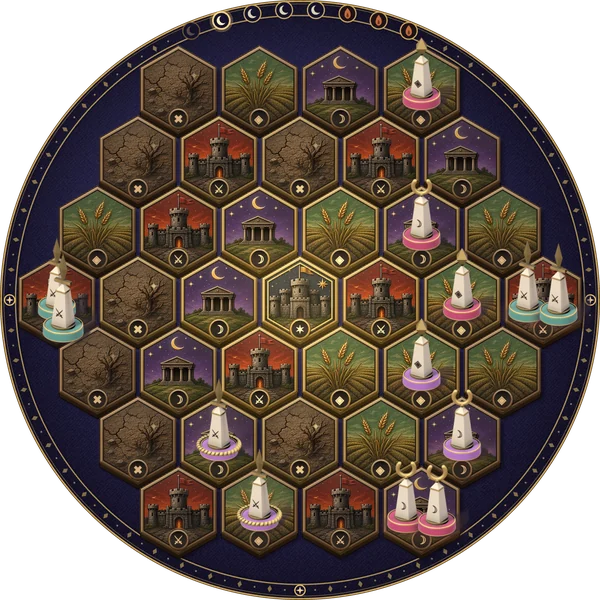
Gilt & Ash is a strategy board game for three to six players, and it runs in a web browser. It's free, with no account and no ads. A match lasts eight seasons, and it can be played with friends online or against the computer. The game sums up its premise in one line: "The empire has tried other methods of succession. This one has fewer funerals."
This post is an introduction: where the idea came from, and what a match is like to play.
Where the Idea Came From
Gilt & Ash is inspired by Iain M. Banks's novel The Player of Games, and in particular by Azad, the game at the center of that book. In the novel, Azad is so complex that it decides who rules an empire. How well people play sets their rank, and the winner of the great final tournament becomes emperor. The book also treats the game as a mirror of the player, so the way someone plays shows what they value.
That's the idea Gilt & Ash borrows. The design notes list the parts it takes from the book: pieces that change form, alliances that are allowed by the rules, formal wagers between players, a fire that advances across the board, and pieces divided into castes. Each player also holds a secret goal that judges how they played, which the notes describe as the novel's central idea. The rules themselves are original. Azad in the novel takes a lifetime to master, and Gilt & Ash is meant to be learned in an evening, so it's a much smaller game.
What's in the Game
- Online play with friends. The host starts a table and gets a five-character join code along with a link to send. Everyone else opens the link, or types the code under Join a table, on any device with a browser, phones included.
- Three to six players. Any seat can be a person or a computer player, and the people can be at the host's device or somewhere else.
- Eight seasons per match.
- Computer opponents at four levels. They're called Novice, Adept, Judge, and Sovereign. The top two plan their fires and treaties ahead.
- Rejoin with the same code. If someone drops out, they can come back with the code they already have, or the host can hand their seat to the computer.
- No account and no ads. The game is free to play.
The game runs on the host's device, which means the host needs to keep it open until the match ends. I think that's probably the main thing to plan around before a long online session. Each device shows only its own hand, and a group in one room can pass a single device around instead.
How a Match Plays
The board has 37 hexes in three rings around a center hex called the Keep. The tiles in each ring are shuffled before every game, so there's no learning the map by heart. Everyone drafts six cards for an opening hand and places their first pieces on the outer ring.
Pieces come in three kinds (Soldiers, Priests, and Merchants), and each kind is fed by its own type of ground. A turn starts with a harvest: one card from the empire whatever happens, plus a card for each hex you hold alone with a matching piece on it. Then you get two actions, mostly spent on moving pieces or changing what kind they are. Two cards buy an extra action, up to twice a turn.
There are no dice. When a piece moves into a rival's hex, both players choose up to three cards, lay them face down, and reveal them together. A card in the piece's own suit counts its value, and any other card counts as one. Each kind of piece has the edge over one other kind, which is worth a point, and a tie goes to the defender. The winner keeps its best card from the duel, and everything else committed is lost. A beaten defender with nowhere to retreat is captured.
Diplomacy and Betrayal
The game sums up this side of a match as "Diplomacy, betrayal and arson, in roughly that order."
On your turn you can deal with other players for free. You can trade cards or agree a pact not to attack each other until a season you name. You can also lay a wager on something everyone can see, like who will hold more Shrines. Breaking a pact is allowed, and it costs two points. A winning wager pays the cards staked on it plus a point.
The rules also say plainly that the table may combine against whoever is leading. Against the computer this is a side system, although the higher levels do propose treaties. With people, my sense is that it probably shapes the match as much as the board does. The game's own line for it is "Nobody has ever been crowned for being nice."
How the Seasons Build
The early seasons are mostly about income. Pieces on their own type of ground pay a card every season, so spreading out across matching hexes tends to matter more than fighting.
At the end of the sixth season, the Fire starts. Three outer hexes burn first. At the end of the seventh, the rest of the outer ring goes, along with two hexes from the middle ring, and more of the middle ring burns at the end of the eighth. The inner ring never burns. As each of these seasons begins, the hexes that will burn are marked on the board, so there's a full season to get pieces out of the way.
If you hold a hex alone when it burns, you bank a point for it, and that's the one point in the game nobody can take back. A piece caught in the fire can escape to a neighboring hex for a card. Otherwise it's lost. Once the Fire has started, the winner of a duel can give up the card it would keep and set a new fire next to the flames instead, anywhere except the Keep. The game's advice is to aim it at the leader.
When the Fire is done, everything still on the board is counted. The Keep is worth four points, each other inner hex is worth two, and pieces score only in the middle and inner rings. Then the secret goals are revealed, worth three or four points each, and the highest total is named Candidate to the Emperor. The Keep's only exits are the six hexes around it, so a defender that loses there with none of them to fall back on is captured. The game puts it this way: "Take some of that ring before you take the Keep."
Skill and Luck
There's some luck in Gilt & Ash. The board is shuffled and cards are drawn. The first fires also land at random. The duels are settled by the cards each player chooses to play, and I'd expect most of the difference between players to show up there.
Every card played in a duel is shown afterward, so a player who keeps track of what rivals have spent knows when their pieces are weak. The game's own advice for a first match points the same way. It suggests attacking where the defender has nowhere to retreat, and watching your secret goal, since three or four points decides most games. A lucky player can win a duel. A good player tends to pick which duels happen at all.
During design, the rules were tested in simulated games between computer players of different strength. In three-player games the strongest won roughly half the time, and the weakest still won about one game in five. Those were simple computer players, so I'd treat the numbers as rough. As the game says, "The rules are simple. The players are not. ...And then you die."
Where to Play
Gilt & Ash is free to play at gilt-and-ash.netlify.app. The Gilt & Ash page on this site walks through a full match. If you try it, I'd suggest a game against the computer first and then a table with people you know.
Gilt & Ash is an independent fan-inspired game. It isn't affiliated with or endorsed by the Banks estate or the publisher of The Player of Games.
It's only a game... And that's the problem.
Free in your browser. No account and no ads.