The empire has tried other methods of succession. This one has fewer funerals.
Gilt and Ash is a strategy board game for three to six players, and it runs in your browser. You spend eight seasons taking ground and fighting over it with cards played face down. In the sixth season the board starts to burn in from the edge, so by the end everyone is crowded into the middle, which is where the points are.
Free, with no account. Play the computer on your own, or seat friends around one device or on their own phones.
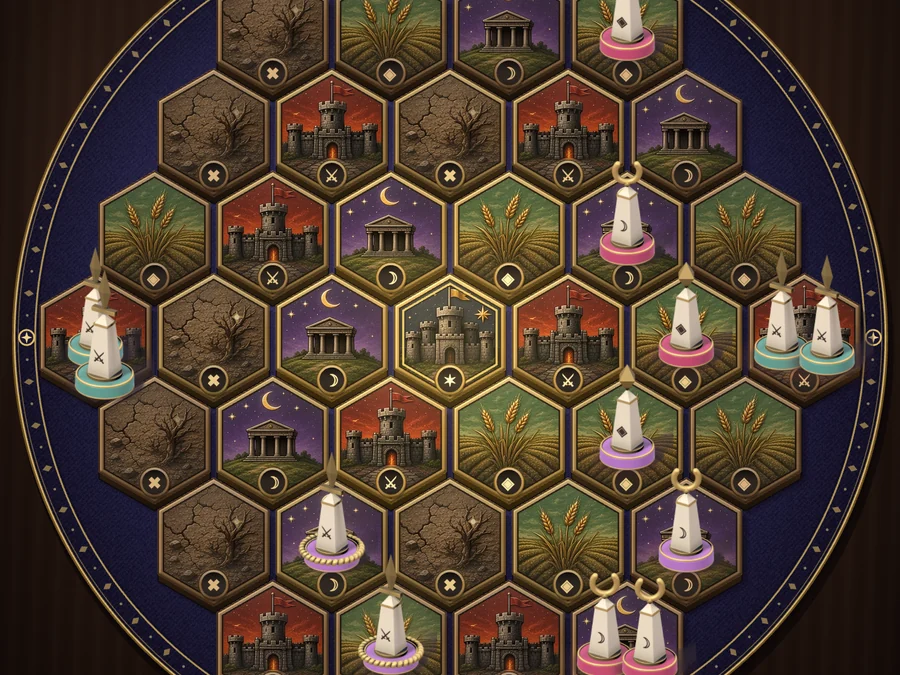
Three players, early in the second season. Everyone is still being polite.
Eight seasons, start to finish
A match starts on empty land and ends in the middle of the board, with whoever is left standing much too close together. Here is roughly how one goes.
The rules are simple. The players are not. ...And then you die.
Setting out the board
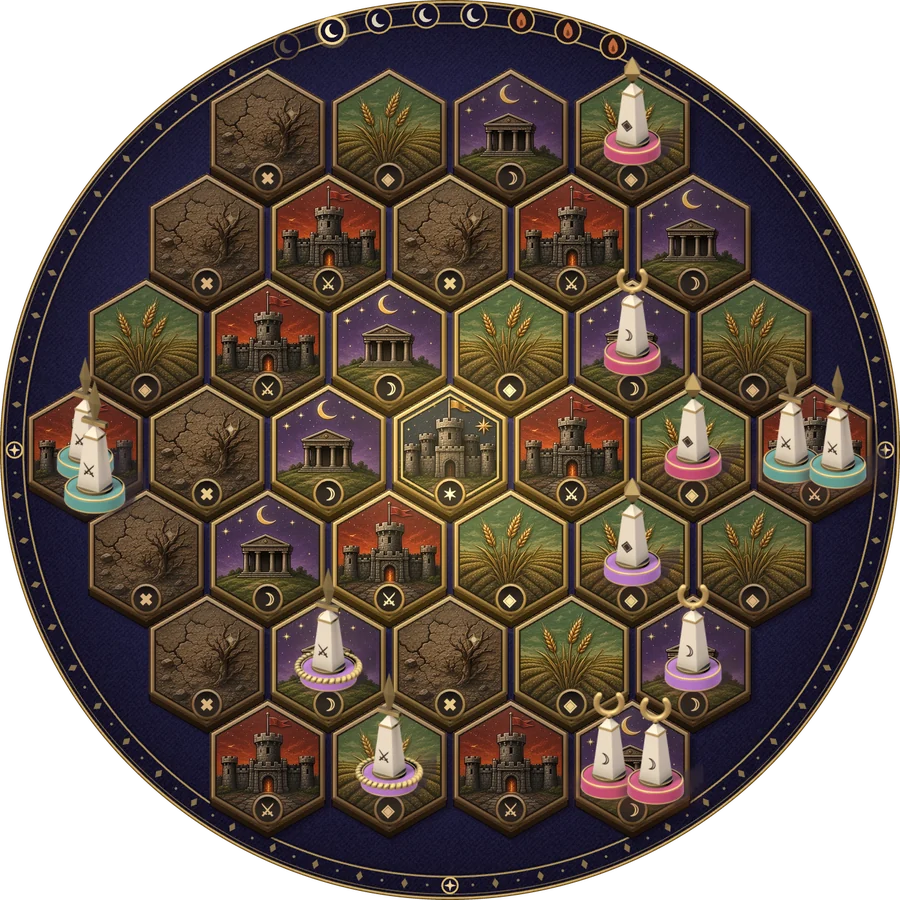
The board has 37 hexes in three rings around the Keep. Fields, Shrines and Garrisons each feed one kind of piece. Wastes feed nobody. The tiles in each ring are shuffled before every game, so there's no learning the map by heart.
- Outer ring
- 18 hexes: 6 Fields and 4 each of Shrines, Garrisons and Wastes
- Middle ring
- 12 hexes, 3 of each kind
- Inner ring
- 6 hexes: 2 Fields, 2 Shrines, 2 Garrisons and no Wastes
- Centre
- The Keep, which everyone wants by the end
Everyone drafts six cards for an opening hand. You're also dealt a few secret goals and keep one, which pays out at the end if you played the way it asked. The first pieces go on the outer ring and the first season begins.
Feeding your pieces
Every piece is a Soldier, a Priest or a Merchant. Soldiers eat from Garrisons, Priests from Shrines and Merchants from Fields. The Keep will feed any of them, which is one reason it gets crowded later.
Your turn starts with a harvest. The empire gives you one card whatever happens, and you draw another for each hex you hold alone with a matching piece on it. Then you get two actions. You can move a piece one hex, change it into another kind, or bring in a new piece on ground you already hold. If you have cards to spare, two of them buy an extra action, up to twice a turn.
Income is counted by the hex. Two pieces stacked on one hex are harder to dislodge, but they share a single card.
Cards, face down
There are no dice. When you move into a rival's hex, you each choose up to three cards, lay them face down and turn them over together. A card in your piece's own suit counts its value and any other card counts as one. Soldiers beat Merchants, Merchants beat Priests and Priests beat Soldiers, and having the advantage is worth a point. A laurel adds a point. So does a second piece on the defending hex, or a defender standing on its own kind of ground. If it's a tie, the defender wins.
The winning piece earns a laurel, which it keeps until it changes kind. A beaten attacker goes back where it came from, turned to the next kind along. A beaten defender retreats and is turned the same way. If it's surrounded it has nowhere to go, so it's captured and the winner takes a card from your hand. Every card played in a duel is shown afterwards, and it's worth remembering what people have spent.
Nobody has ever been crowned for being nice.
Friends, for the time being
On your turn you can offer another player a trade, a pact not to attack each other until a season you name, or a bet on something everyone can see, like who will hold more Shrines or be sitting on the Keep. Breaking a pact is allowed. It costs you two points.
A winning bet pays the cards staked on it, plus a point. If one player gets too far ahead, the rest are entitled to gang up on them, and usually do.
Diplomacy, betrayal and arson, in roughly that order.
The Fire comes in from the edge
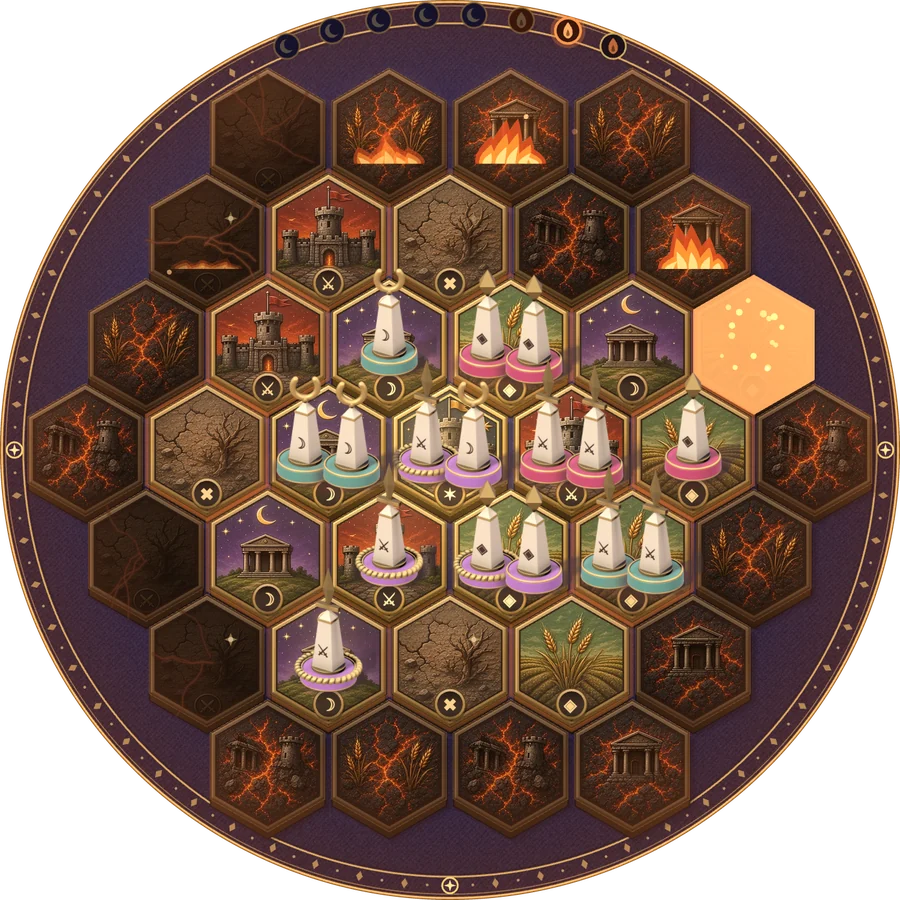
At the end of the sixth season, three outer hexes drawn at random catch fire. At the end of the seventh the rest of the outer ring burns, along with two hexes from the middle ring. At the end of the eighth another six middle hexes go. The inner ring never burns.
If you hold a hex alone when it burns, you bank a point for it, and that's the one point in the game nobody can take back. A piece caught in the fire can escape to a neighbouring hex for a card. Otherwise it's lost. Once the fire has started, the winner of a duel may give up the card they would keep and set a new fire next to the flames instead, anywhere except the Keep. People tend to aim it at whoever's winning.
Everyone ends up at the Keep
By the eighth season there isn't much board left, and everyone is on it. The Keep is worth more than any other hex and feeds any piece. The catch is that its only exits are the six hexes around it. A defender that loses a duel on the Keep has to retreat into one you hold, and if you hold none, the piece is captured where it stands.
Take some of that ring before you take the Keep.
The count
When the Fire is done, everything you still hold is counted. A lead in the fifth season doesn't mean much.
- The Keep
- 4 points
- Inner ring
- 2 points for each other hex you hold there
- Pieces
- 1 point for each piece left in the middle or inner ring, 2 if it still has its laurel
- Ashes
- 1 point for each hex you held alone when it burned
- Wagers
- 1 point for each bet won, minus 2 for each pact broken
- Secret goal
- 3 or 4 points if you met it
Then the secret goals are shown. Hold two Shrines, say, or win duels with all three kinds of piece, or keep two laurels to the end. The highest total is named Candidate to the Emperor. A tie goes to whoever has the most cards left.
Playing from different places
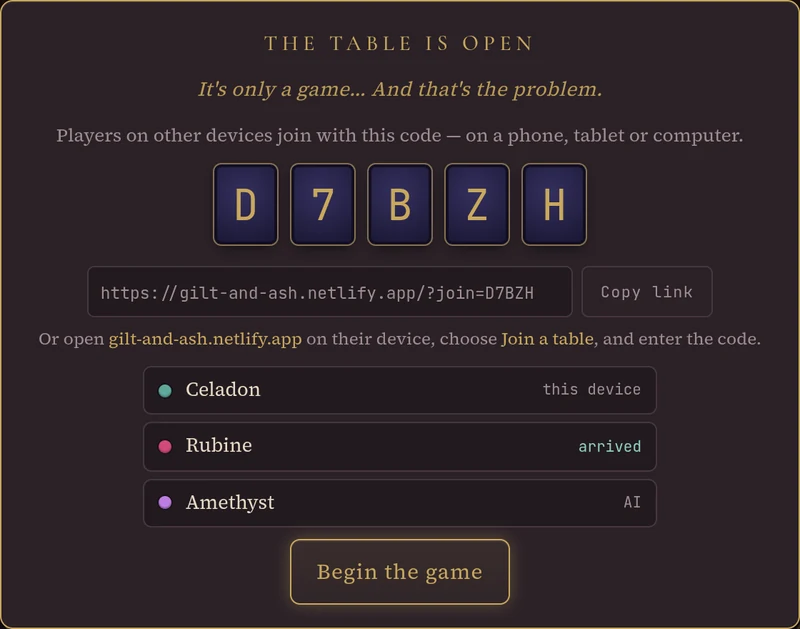
The host starts a game on their own device and gets a five-character code and a link to send round. Everyone else opens the link, or types the code under Join a table, and takes the seat kept for them. A phone, tablet or computer will do. Seats can be people at the host's device, people elsewhere or the computer, in any mix, and each device shows only its own hand.
The game runs on the host's device, so the host has to keep it open. Anyone who drops out can rejoin with the same code, or the host can hand their seat to the computer.
The practical part
- Players
- Three to six. A seat can be someone at this device, someone on another device or the computer.
- Opponents
- Computer players at four levels: Novice, Adept, Judge and Sovereign.
- Learning
- A seven-page guide to the rules, a rules tab during play, and a tip the first time each situation comes up.
- Saving
- A game on one device saves in the browser after every move. You can close the tab and come back to it.
- Online play
- Yes. The host sends a code or link and the others join on a phone, tablet or computer. No accounts. The host's game has to stay open.
- Price
- Free. No account and no ads.
FAQ
Is there any luck in it?
Some. The board is shuffled, cards are drawn and the first fires land at random. There are no dice. Duels are settled by the cards each player chooses to play.
How do several people play on one device?
Set up everyone's seat at the start. Between turns the screen hides the hands until the next player takes over, so you can pass a laptop or tablet round without anyone seeing your cards.
How do we play from different places?
When you set up, choose Online for the seats of anyone who isn't with you, then start. You'll get a five-character code and a link to send. Each player opens it, types a name and takes a seat. Once everyone has arrived, start the game.
Where does the idea come from?
It is inspired by the game of Azad in Iain M. Banks' novel The Player of Games. The rules here are our own.
Why is it free?
It started as a game to play at home. There's nothing to buy.
It's only a game...
And that's the problem.
It runs in the browser and costs nothing. Learn against the computer first, then try it on people you know.