The retirement planner that shows its work
Enter a few numbers and get the earliest age you could retire, the changes that move that date, and the tax and penalties behind it, year by year.
Free during early access. No account needed.
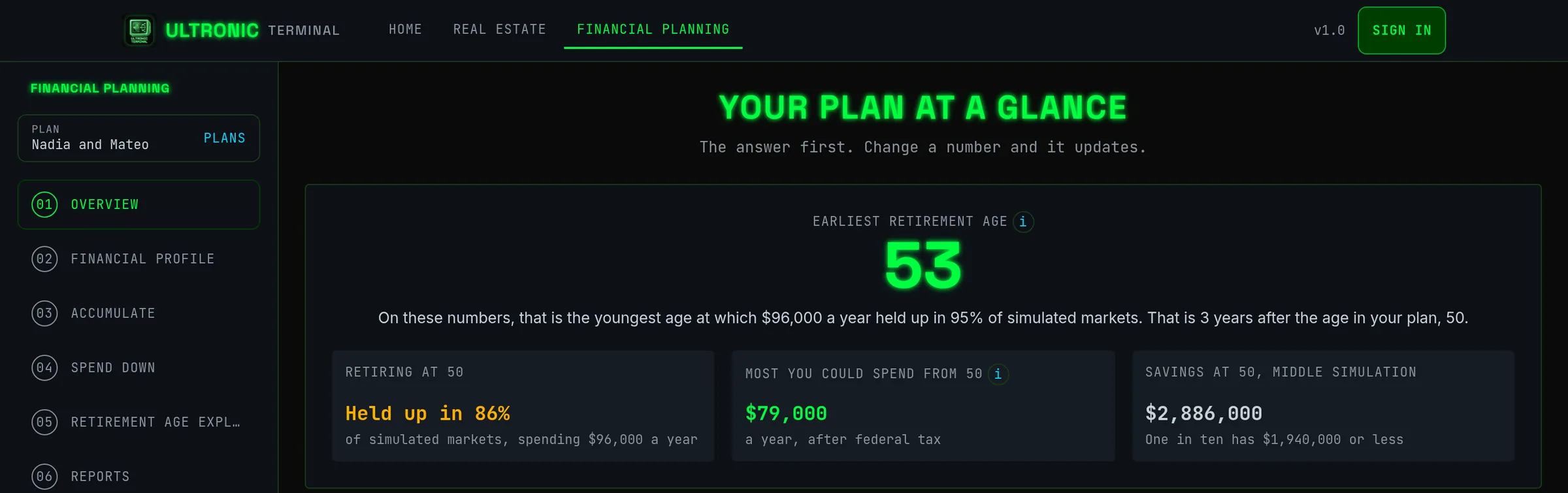
Screens show an example household. Simulation, not advice.
Seven steps, in the order you'll use them
Ultronic runs your plan through up to 2,000 simulated markets and counts federal and state tax, the 10% early-withdrawal penalty and required distributions in every year. Each step answers one question.
Six numbers in, an earliest retirement age out
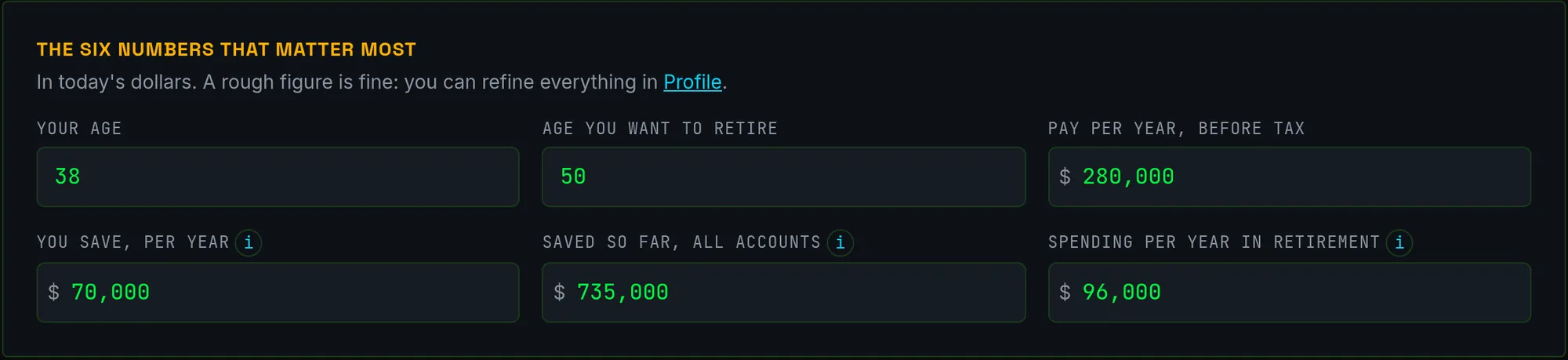
Your age, the age you want to retire, pay, yearly savings, what you've saved and what you plan to spend. The first screen answers with the youngest age your spending holds up, and refines as you add accounts, Social Security and pensions.
See which changes move your date
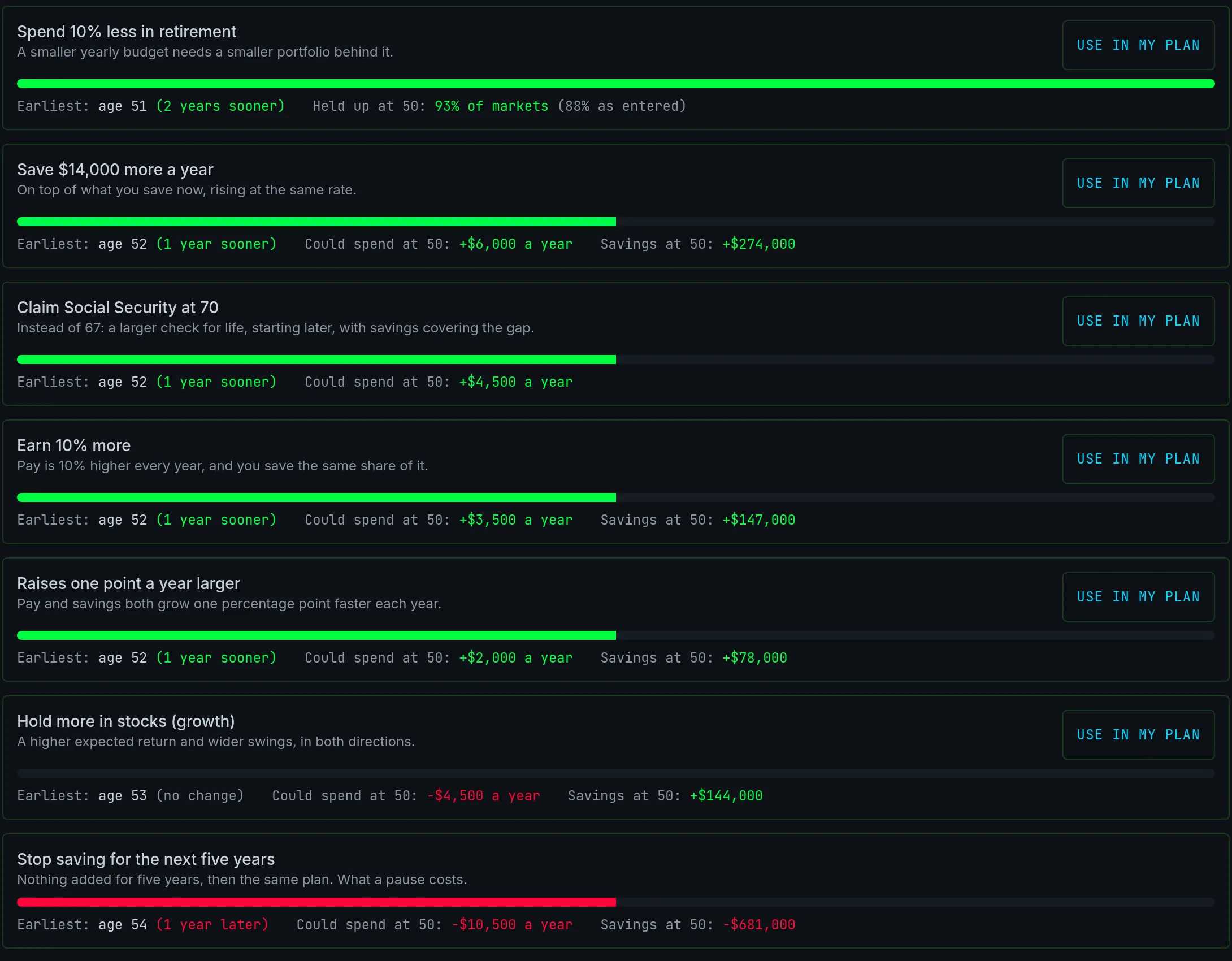
Ultronic changes one thing at a time, such as spending less, saving more, claiming Social Security later or holding more stocks, and reruns the plan through the same simulated markets. Each row shows the new earliest age, so you can see which choices matter and which don't.
Retiring before 59½, penalties counted
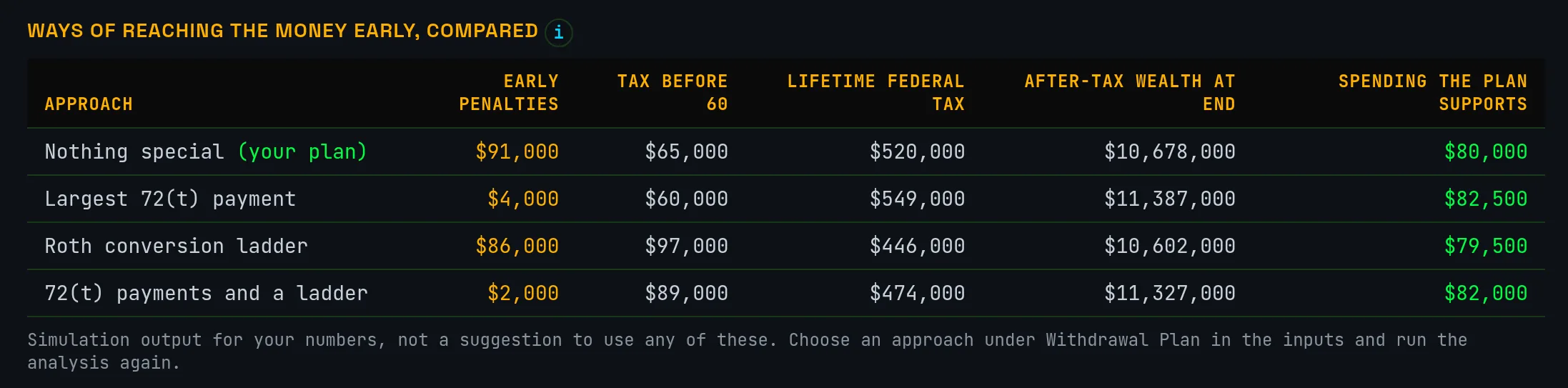
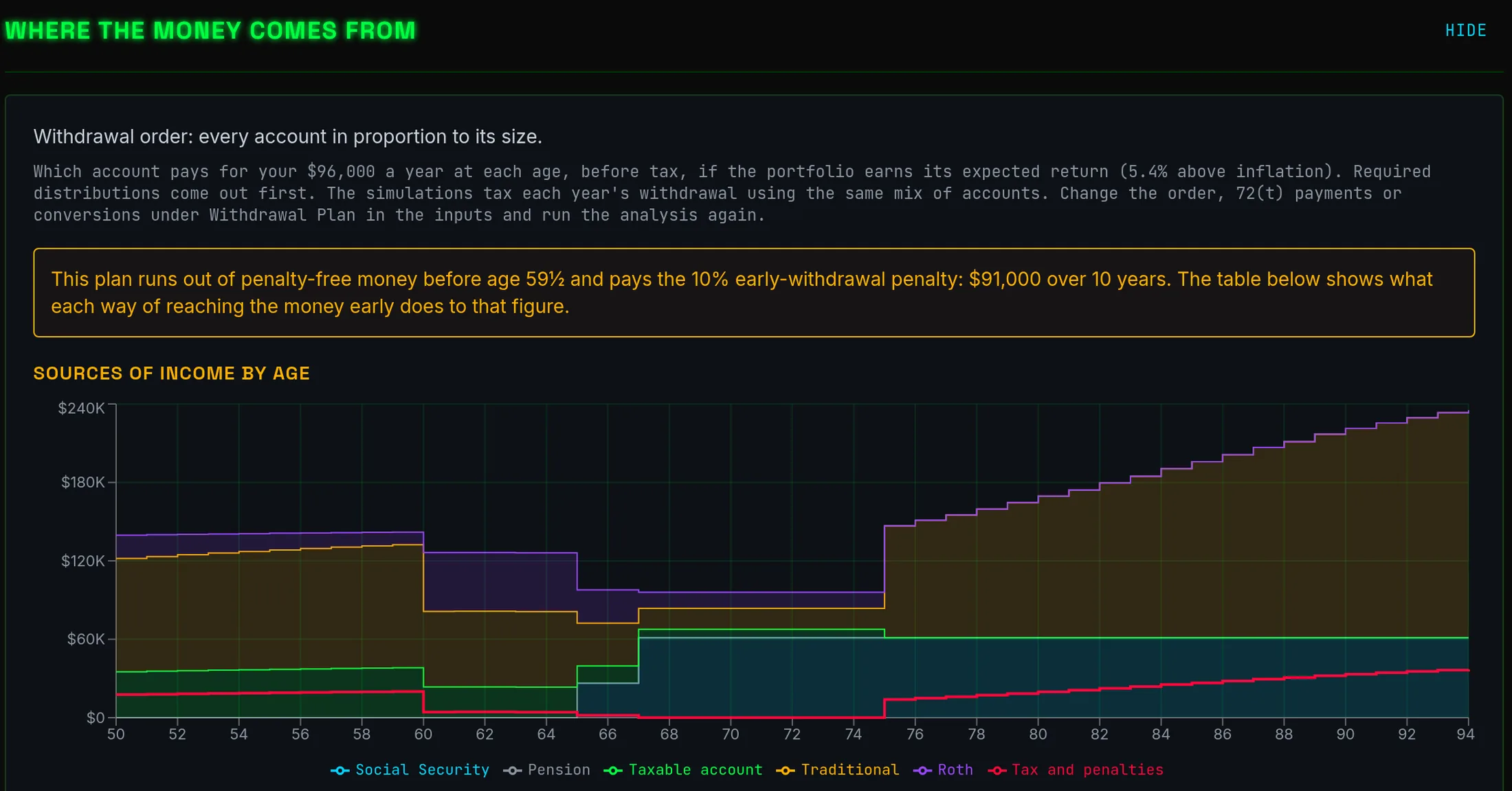
Money in 401(k)s and IRAs carries a 10% penalty before 59½. Ultronic compares the ways around it, 72(t) payments, a Roth conversion ladder or both, and shows the penalty and the spending each one supports. In this example the penalty is $91,000 as entered and $4,000 with 72(t) payments. The age-55 rule is a setting.
Which account pays, every year, after tax
For each year of retirement you see how much comes from taxable accounts, traditional accounts, Roth, Social Security and pensions, and how much goes to tax and penalties. Account balances are charted by age underneath.
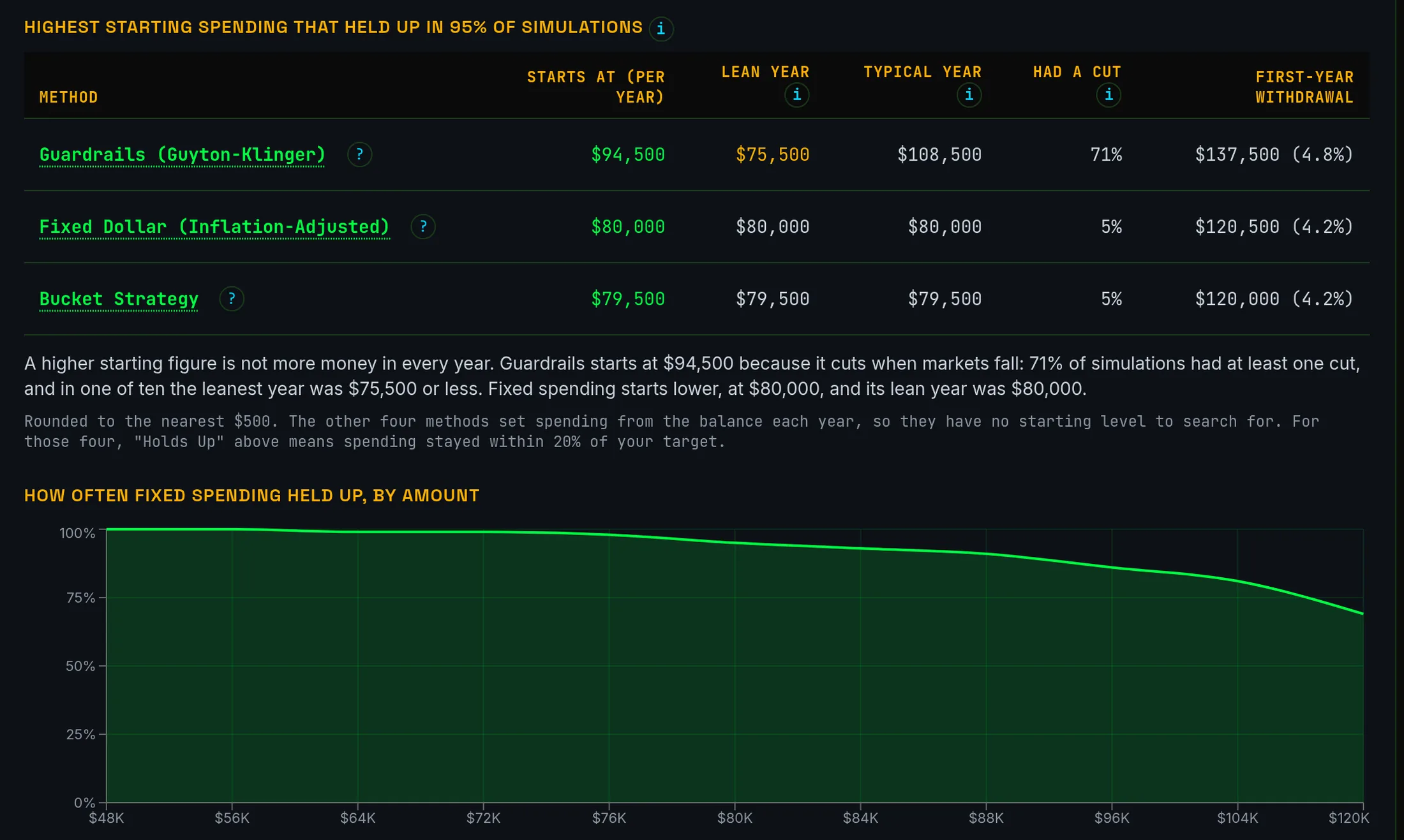
How much spending holds up
A plan holds up when spending never has to drop below 80% of where it started. Ultronic compares seven withdrawal methods. For the ones that start from a set amount, it finds the highest starting spending that holds up in 95% of simulated markets, with the lean year and how often a cut was needed.
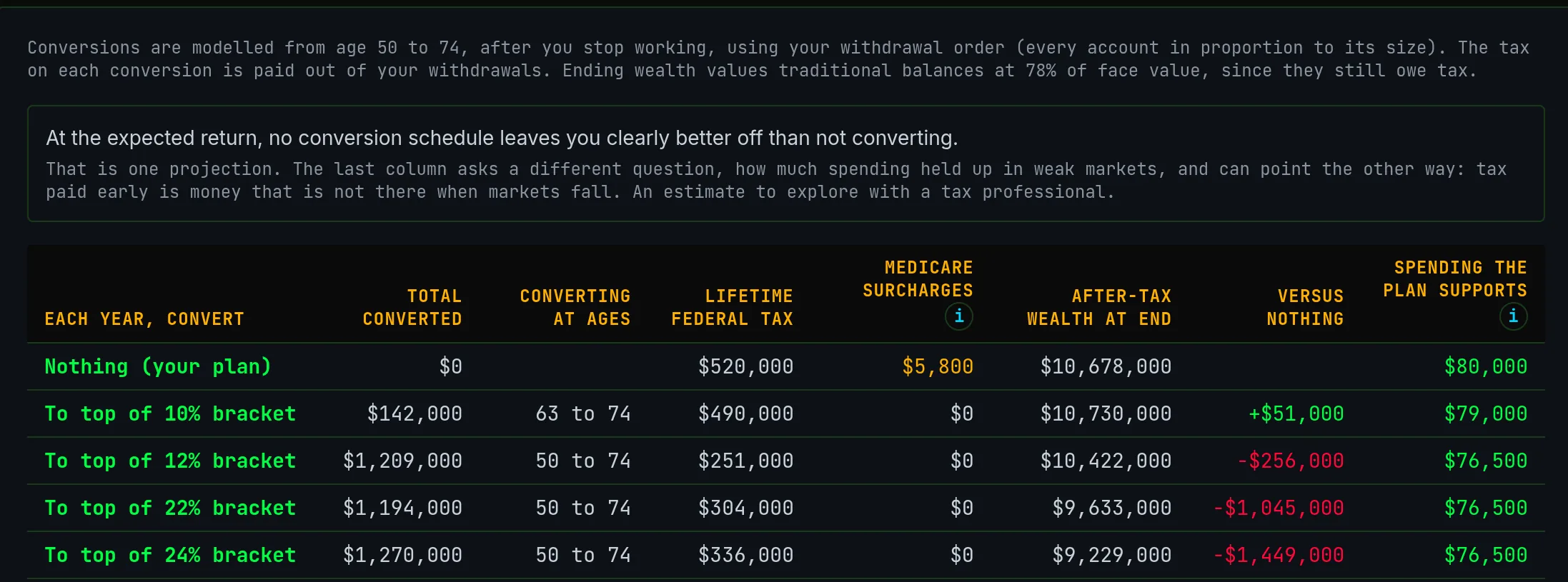
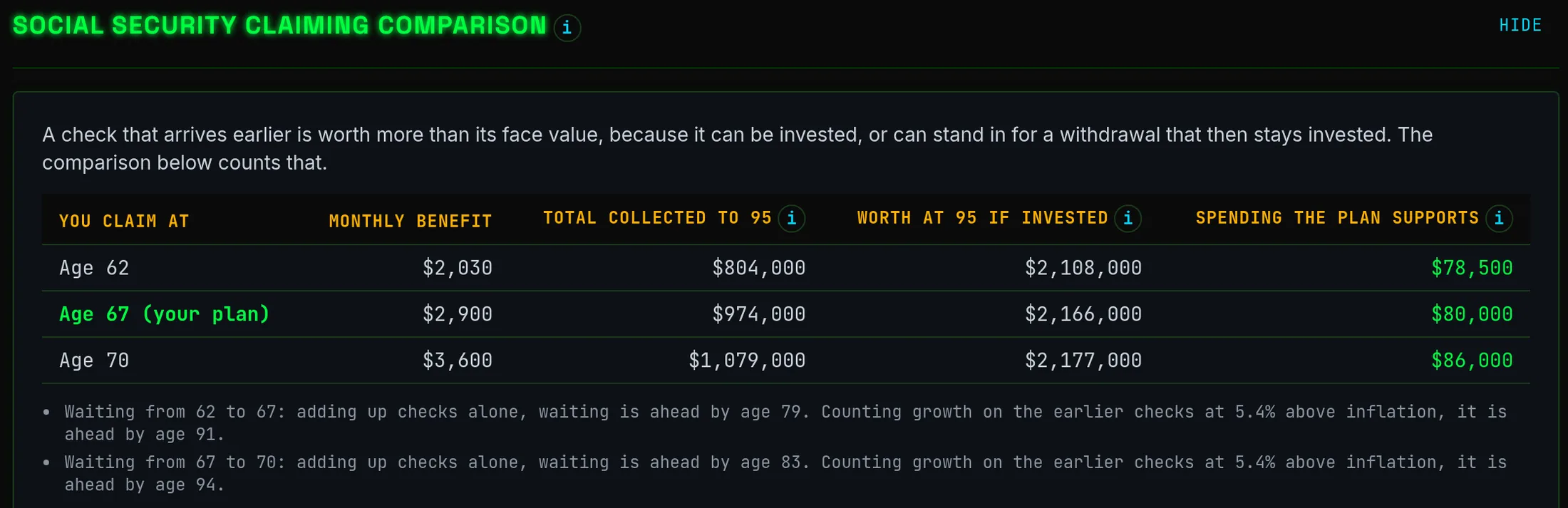
Roth conversions and Social Security, both sides shown
Roth conversion schedules are compared on lifetime tax and on what you end up with, because lower tax does not always leave more money. Social Security is compared at 62, 67 and 70 on total collected, value if invested, and the spending the plan supports.
Every retirement age against every spending level
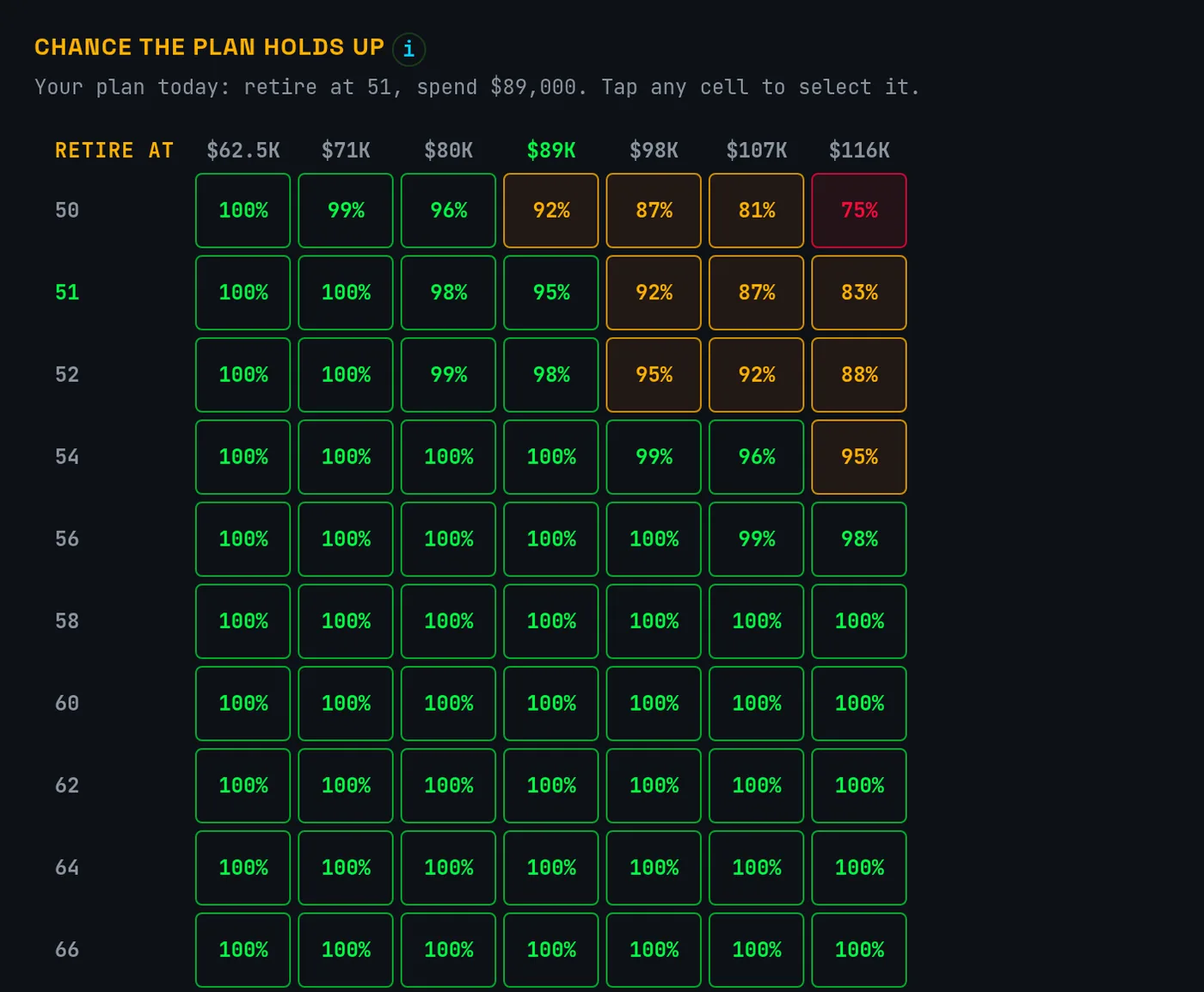
The Retirement Age Explorer fills a grid with how often the plan holds up at each age and spending level. Pick a cell and it becomes your plan.
Plan the working years too
The years before retirement decide most of the outcome, so the Accumulate screen models them in the same detail.
Year by year to your last working year
Raises, savings that grow each year and any employer match, charted to the age you stop, with the total you'll have paid in.
Where each dollar of savings goes
Your yearly savings filled into each account type in a commonly used order, up to this year's limits, with the federal tax deferred.
A first plan from five numbers
Before a first job: your age, when you expect to start earning, starting pay, the share you'll save and the spending you want later.
Download the plan as a spreadsheet with live formulas
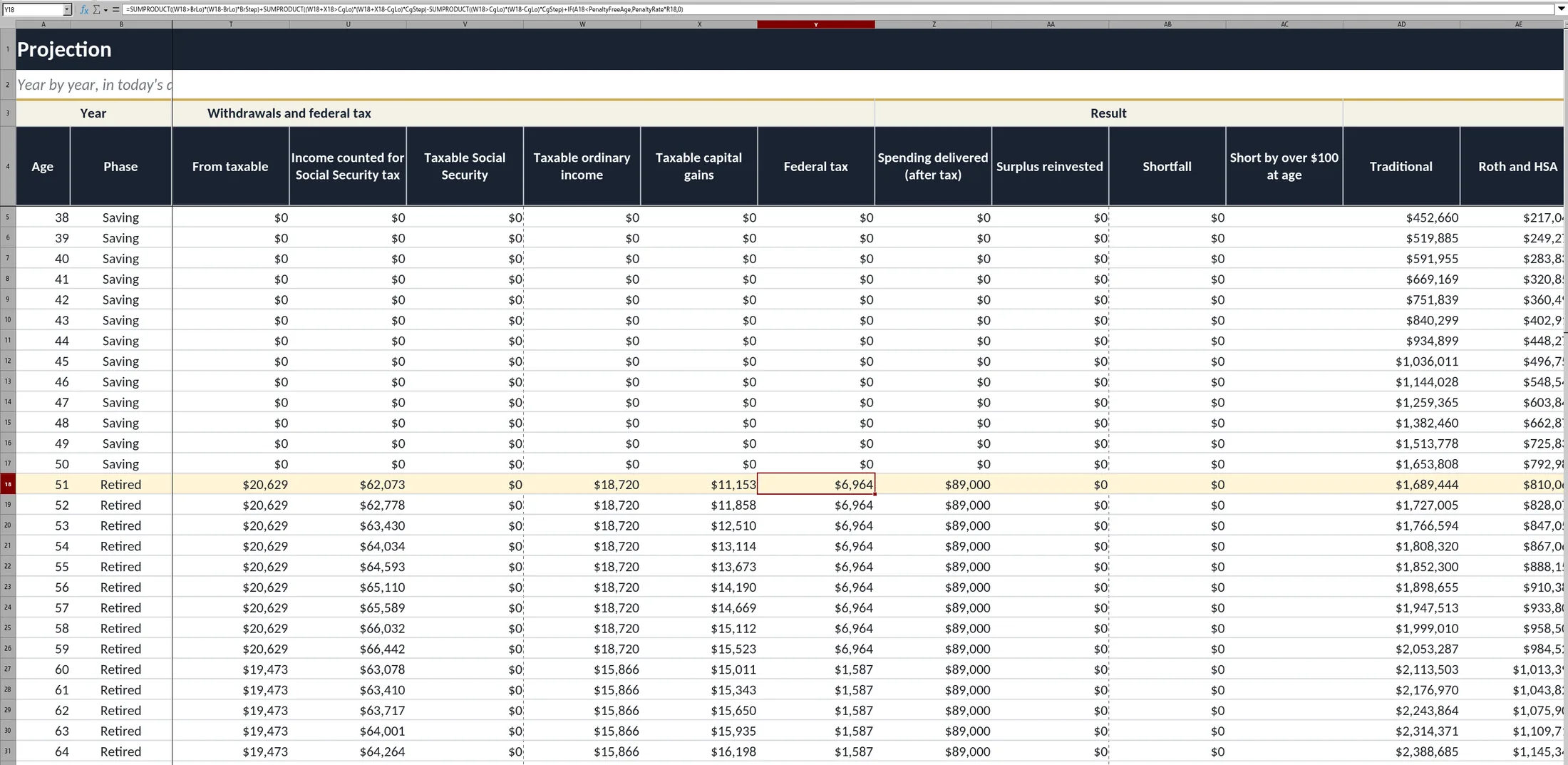
The Plan Calculator for Excel rebuilds your projection as formulas. Change an input and the balances and federal tax recalculate, with no connection to the app. It uses one steady return rather than simulated markets, so you can follow every line.
Assumptions
- Markets
- 2,000 simulated markets on the Spend Down page, 1,000 for what moves your retirement date, 600 on the overview. Screens can differ by a year near a cut-off.
- Stocks
- Real return averaging 8.65% a year (about 6.7% compounded), with a 19% standard deviation and stronger and weaker market periods.
- Bonds
- 2.5% real return, 7% standard deviation.
- Inflation
- You set the long-run average, 2.5% to start. Each year varies and drifts back toward it.
- Mix
- 30/70, 60/40, 80/20 or 100/0 stocks to bonds.
- Holding up
- Spending never falls below 80% of where it started. The earliest age is the youngest age where that's true in 95% of markets.
- Federal tax
- 2026 brackets, capital gains rates, taxable Social Security, the Medicare surcharge and the 3.8% investment income tax.
- State tax
- A flat rate you set, up to 15%, on income other than Social Security.
- Before 59½
- A 10% penalty on traditional withdrawals, applied through the year you turn 59. 72(t) payments use fixed amortization at 5%. The age-55 rule is an option. Roth conversions are reachable after five years.
- Medicare
- From 65. Health cover before then is the yearly amount you enter.
- Dollars
- Everything is in today's dollars.
What it doesn't do yet
- It doesn't link to your bank or brokerage. You type in balances.
- One stock and bond mix is held for the whole plan. There's no glide path.
- State tax is a flat rate on income other than Social Security. State exemptions for pension or retirement income aren't modelled.
- Health cover before Medicare is a yearly amount you set. Marketplace subsidies aren't modelled.
- Investment fees, long-term care, and what a surviving spouse would have after a death are left out. So are survivor and spousal Social Security benefits.
- Roth 401(k) and HSA money is treated like a Roth IRA for early access.
- It doesn't search for a lowest-tax schedule. It shows the tax that follows from the plan you set, with alternatives side by side.
- Simulated markets have fewer deep multi-year declines than history has had. Real markets can be worse than any simulated path.
Your data
- Your plan is saved in your browser, on your device. You don't need an account.
- Signing in is optional. It's there to sync a plan between devices, which is part of Pro.
- The app counts which screens are opened and which buttons are used, so we can see where people get stuck. Those events never include ages, balances, income, results or who you are.
- That counting stops when your browser sends Do Not Track or Global Privacy Control.
- No ads, and we don't sell personal information.
- You can delete your account and synced data from the account menu at any time.
Free and Pro
Everything is open during early access. Pro pricing at launch.
Free
- Overview and full financial profile
- What moves your retirement date
- Pay, savings and contribution order
- Spend-down results: how often spending holds up, seven withdrawal methods compared, balance by age
- Withdrawal order, Roth conversions, 72(t) payments and cost basis in every plan
- Plain-language explainers and the help assistant
- One plan, kept on your device
Pro
Pricing at launch- Where the money comes from each year, the federal tax picture and required distributions
- Before 59½: 72(t) payments and Roth ladders compared
- Roth conversion and Social Security claiming comparisons
- Any withdrawal method followed year by year, with tunable rules
- Retirement Age Explorer
- Multiple named plans
- PDF, Excel and CSV export, and the Plan Calculator for Excel
- Cloud sync across devices
FAQ
What does it cost?
Free during early access. Pro pricing at launch.
Do I need an account?
No. Open the planner and enter six numbers. Your plan stays in your browser.
Does it work on a phone?
It runs in any browser, phone included. The tables and charts are easiest to read on a laptop or desktop.
Why do two screens sometimes disagree by a year?
Each screen runs a different number of simulated markets. The overview uses fewer so it answers quickly, and the Spend Down page uses more. Near a cut-off, the earliest age can land a year apart.
Should I act on these numbers?
Treat them as a simulation of the inputs you gave it. For a large move, like a Roth conversion schedule or 72(t) payments, check it with a tax professional first.
Screens show an example household. Simulation, not advice.