See what a house could become, and whether the numbers work
Start from the listing you're looking at: paste the link, or copy the page. Root Logic labels each room, sketches the renovation, prices it line by line, and works out how the house does as a flip, a short-term rental or a long-term rental. You see all of it before you make an offer.
Root Logic is being tested with a small group. Send us a note and we'll write when there's room for more.
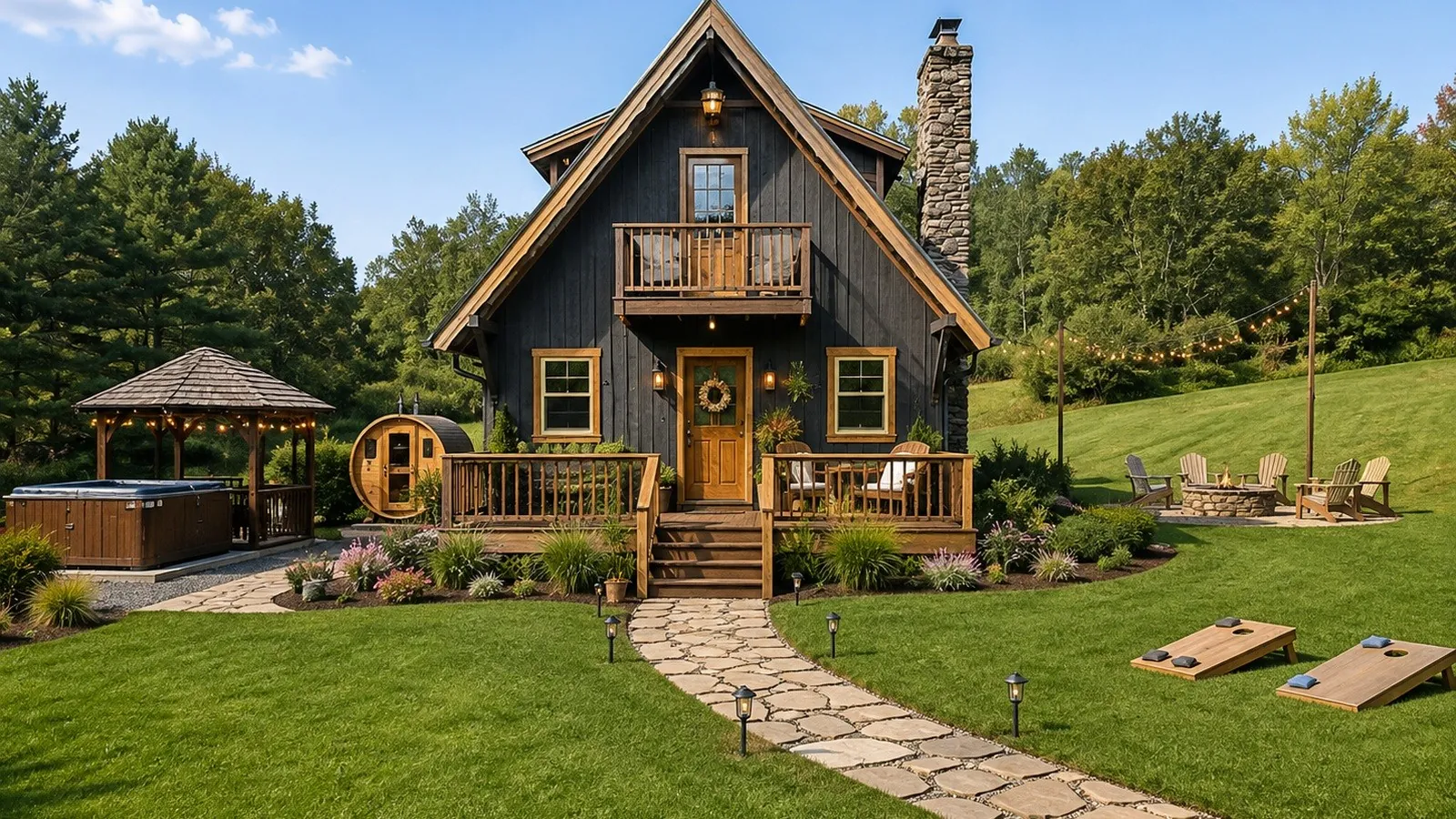
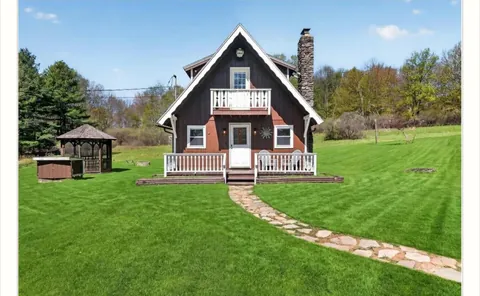 Before
A real house run through Root Logic, address hidden. The inset is the listing photo; the large image is the concept drawn from it.
One house, from listing to an answer
Each step builds on the one before. The listing brings in the photos, the photos shape the concepts, the concepts you keep become the budget, and the budget feeds the numbers. The screens below follow one real house through the app: a dated chalet on five acres of open lawn, planned as a short-term rental, with the address and listing details hidden.
Start from the listing
Choose your plan, fix and flip, short-term rental, long-term rental or a home to live in, and paste the link to the listing you're looking at. Root Logic fills in the details and finds the photos. Some listing sites, Zillow and Redfin among them, often refuse to be read this way. When that happens, copy the whole listing page and paste it in, or type the facts and add the photos yourself.
Each photo gets a room label and a short note on its condition and what could change. You can correct any label.
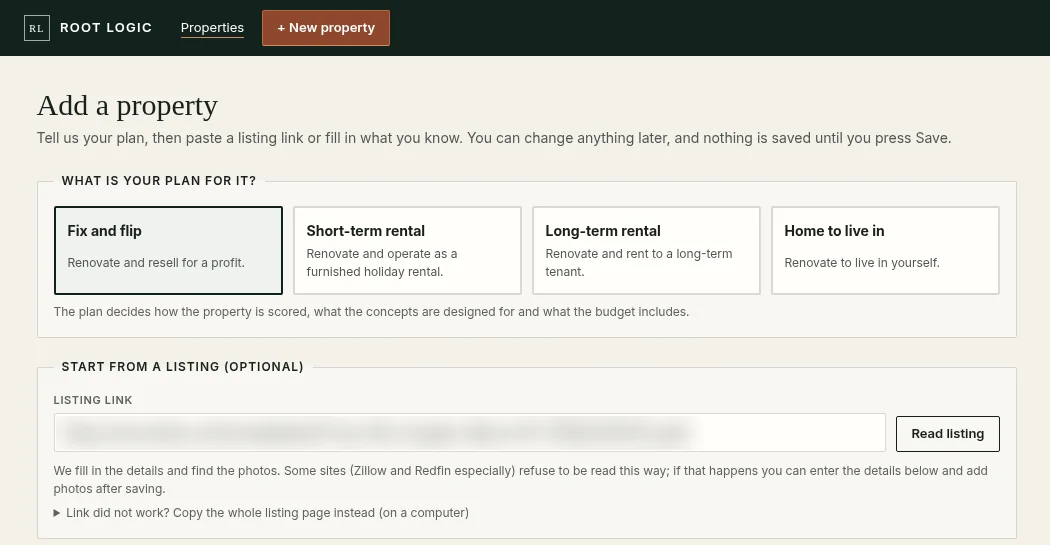
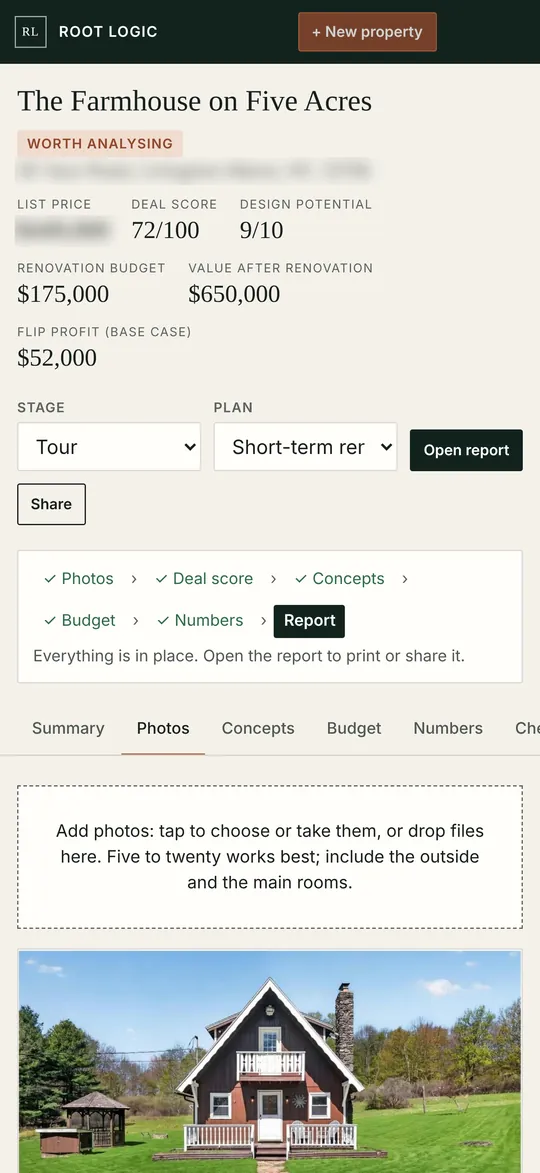
The listing link, address and list price are blurred in these screens.
See what it could become
Choose from five design styles and three depths of renovation, from a cosmetic refresh to a full transformation, and Root Logic uses AI to draw a concept from each photo. Compare before and after, try another version, and keep the one you want for each room.
For a short-term rental you can add guest amenities to the plan. On this house that meant a hot tub, a barrel sauna, a fire pit and lawn games out front, and the two-car garage turned into a game barn. Concepts show intent. They are not construction drawings, and details may not be buildable as drawn.
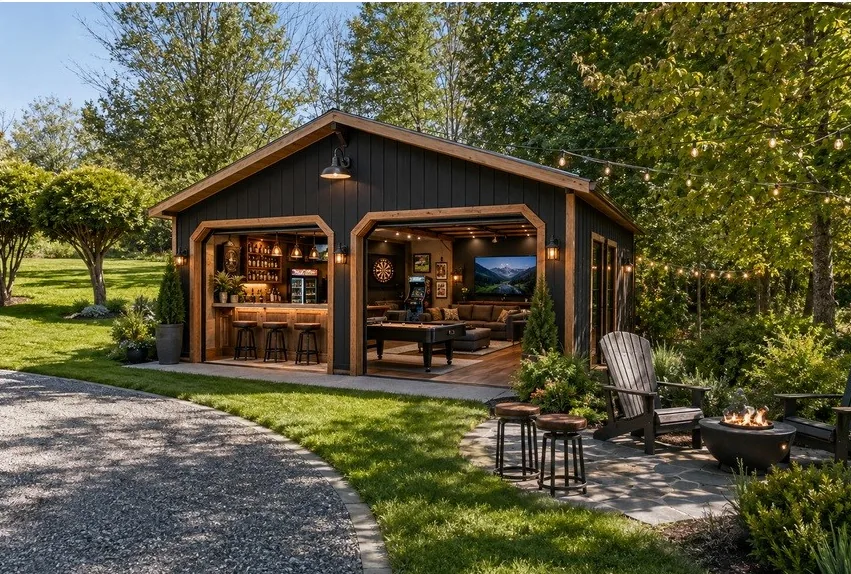
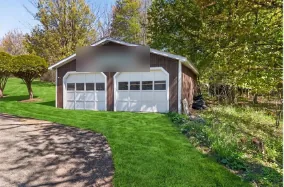 Before
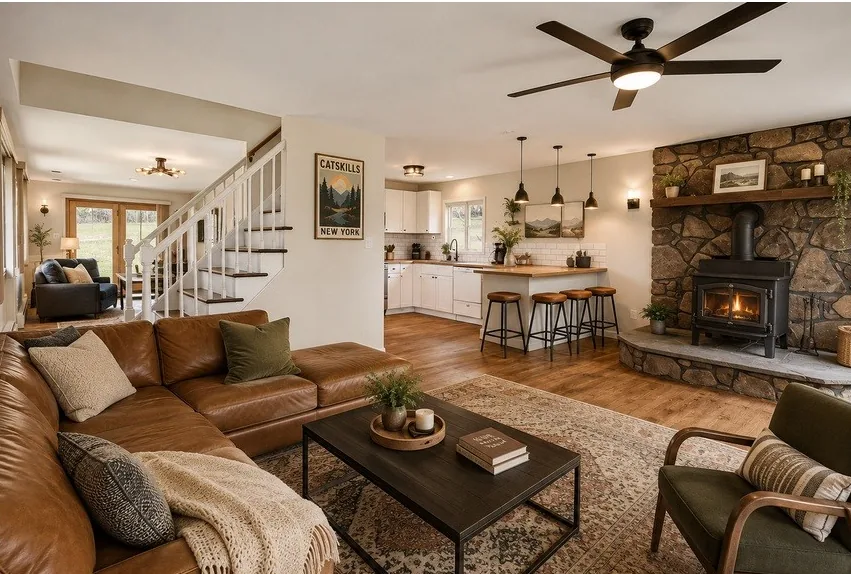
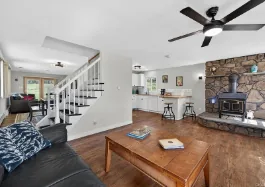 Before
Small insets are the listing photos. The garage sign is blurred.
A budget built from the concepts you keep
Root Logic compares each concept you kept with its original photo and prices the difference, line by line. You get a base estimate with a range, building work kept apart from furnishing and equipment, and a list of what was left out. Every line can be edited. Replace an estimate with your own figure, a bid or an invoice, and the budget shows how much of it is verified. It downloads as a spreadsheet.
For this house the base estimate is $175,000, with a range of $137,850 to $230,725, and every line has been checked.
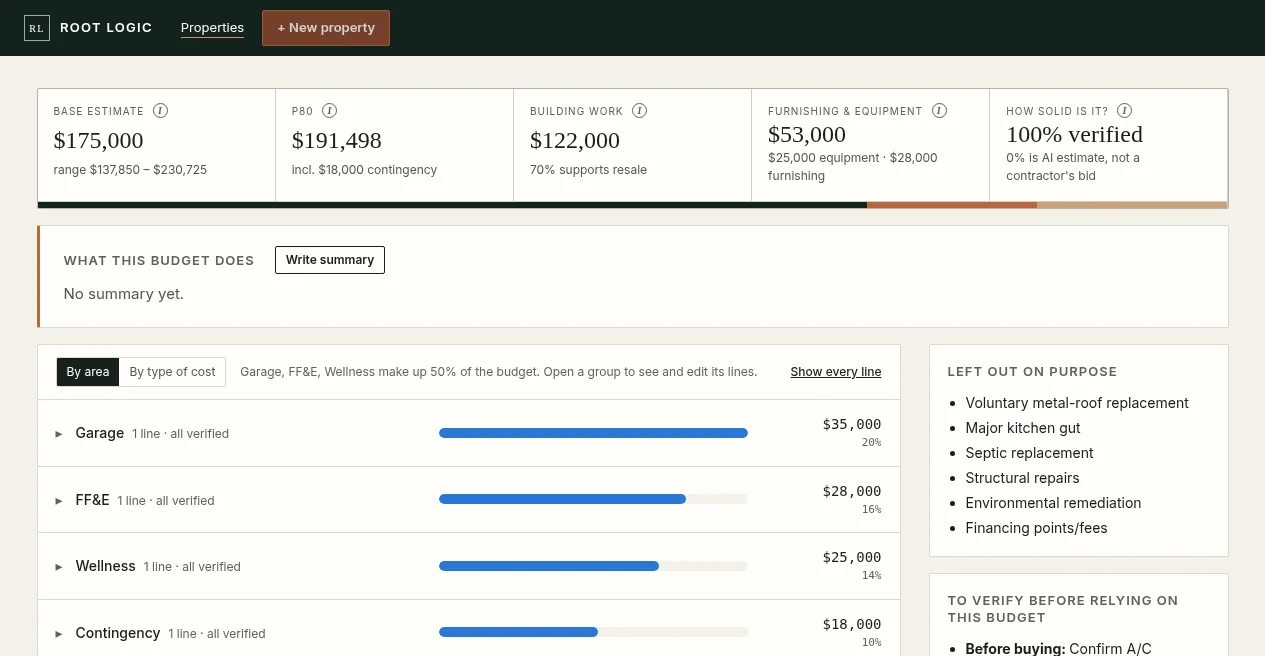
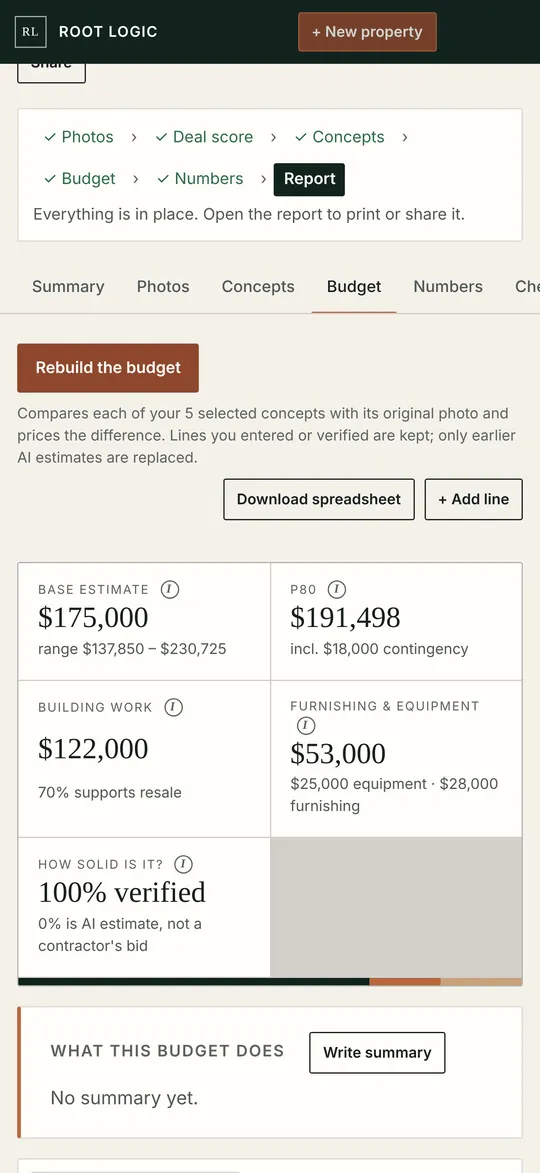
Estimates until you replace them, not a contractor's bid.
A deal score for the plan you picked
The deal score weighs the property against your plan. For a short-term rental that means guest demand, privacy, amenity potential and the risk of hidden costs, each with its weight shown. It lists strengths, weaknesses and deal-breakers, and says how confident it is in its own read. Treat it as an opinion to test, not an appraisal.
This house scores 72 out of 100, worth analysing, with a design potential of 9 out of 10.
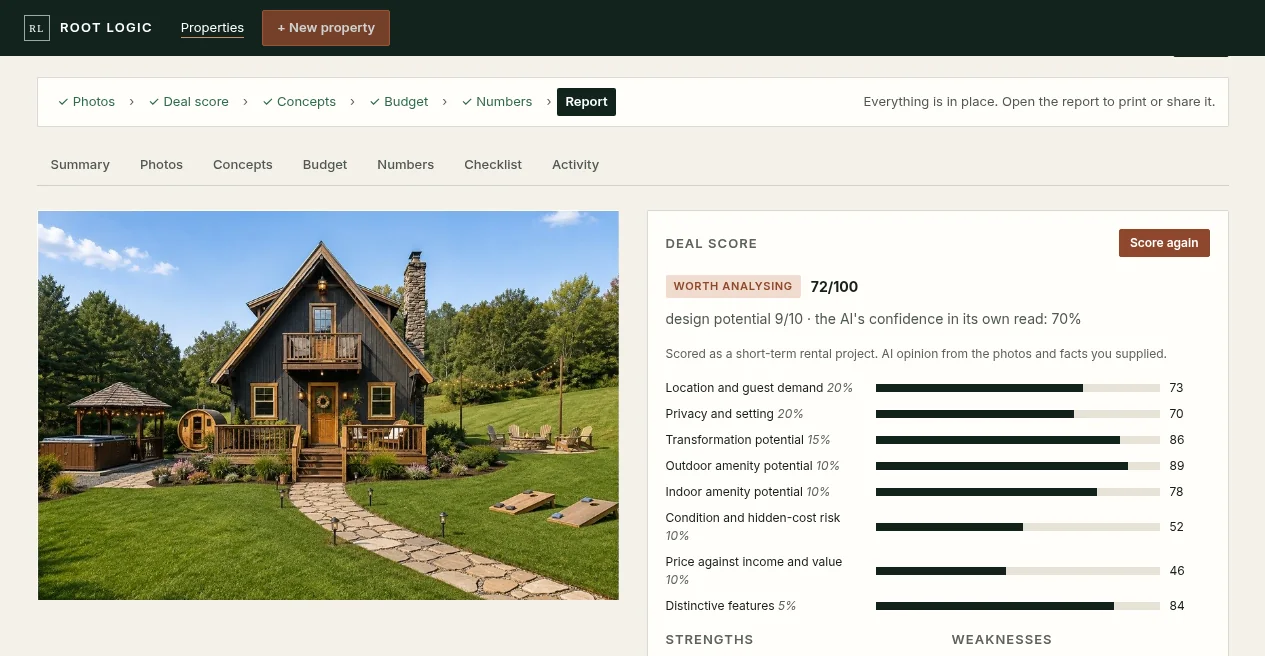
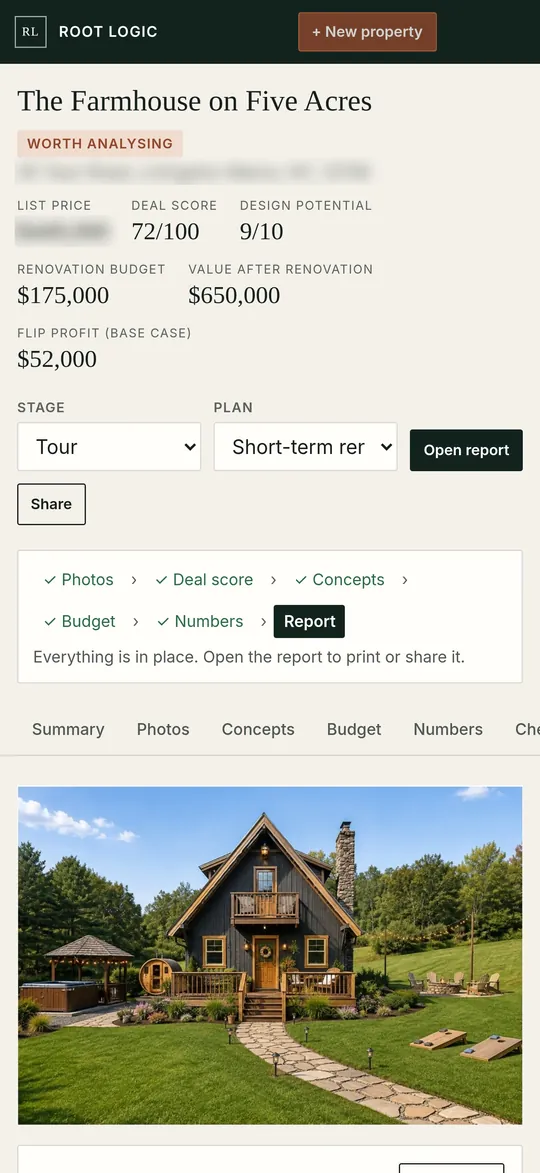
The house image on the summary is an illustrative concept.
Numbers that tell you if it works
Add sold comps, rental comps and your loan. From those figures Root Logic works out the value after renovation, the cash you put in, the total project cost, income cases, break-even and a set of safety checks. It compares selling, short-term renting and long-term renting, each with or without a refinance, and suggests what to pay. This part is plain arithmetic on your figures, so the same inputs always give the same answer.
On this house, renovating and selling after 12 months for $650,000 keeps $52,000 after every cost, 14.5% on the cash put in, the strongest of the options on these figures.
It also says when an answer rests on a guess. The nightly rate and occupancy for this house haven't been checked yet, so the short-term rental figures carry a "treat this as a sketch" warning until they are.
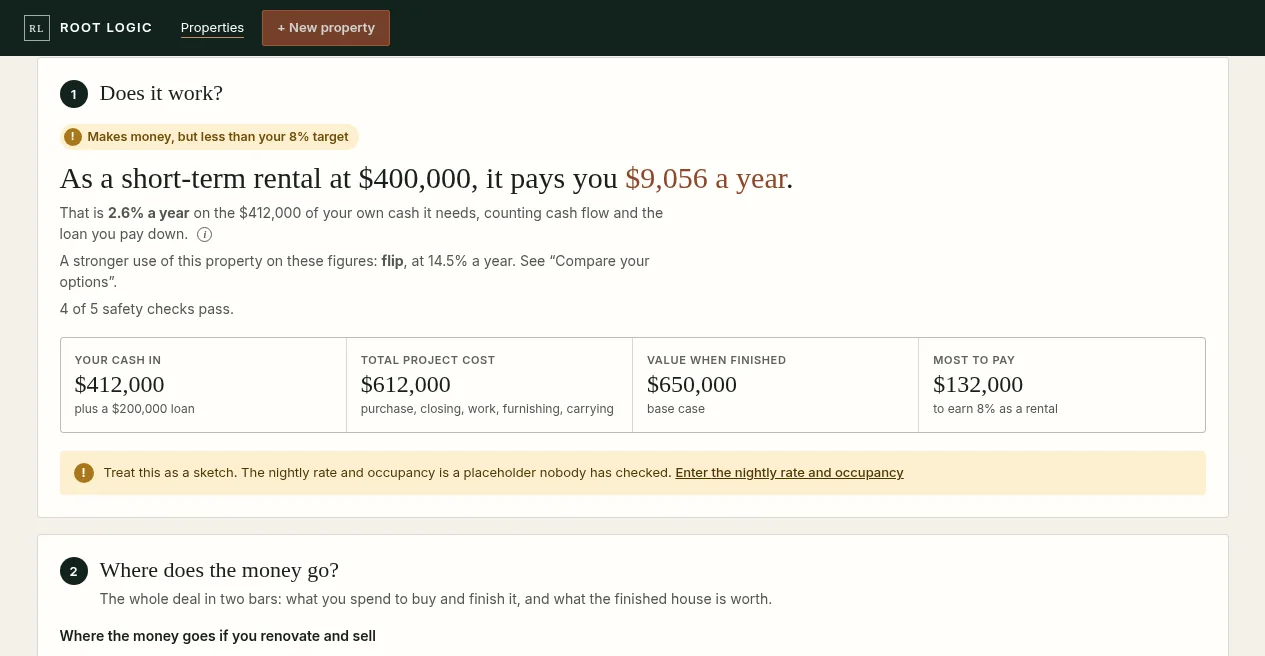
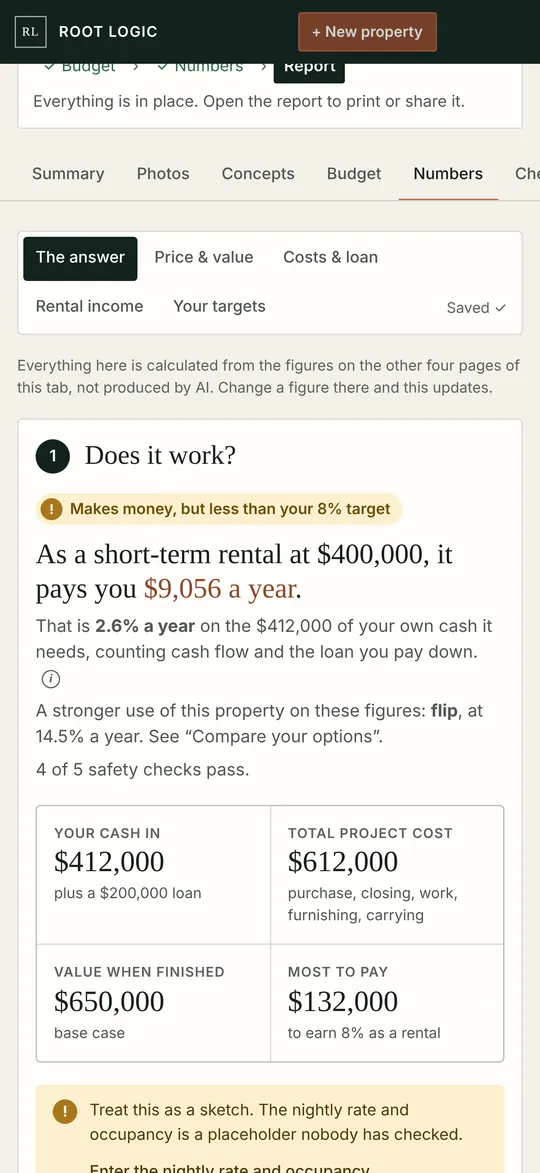
Rental figures here use a placeholder nightly rate. Projections, not a guarantee of returns.
What it does and doesn't do
- Listings
- Reads a pasted link where the site allows it. Many listing sites block automated reads, so copying the page or typing the facts is often the way in.
- Concepts
- Design studies drawn from your photos. They show a direction, not a plan a builder can work from.
- Budget
- Lines start as estimates and stay that way until you replace them with your own figures, bids or invoices.
- Value and income
- Come from the comps and figures you add. Root Logic doesn't pull market data or appraise the house.
- Local rules
- It doesn't check zoning, permits or short-term rental rules. Confirm those with the town before you buy.
- Report
- Everything comes together in one report you can print or save as a PDF.
FAQ
Can I use it now?
Root Logic is in development and being tested with a small group. Join the early-access list and we'll write when there's room for more.
What will it cost?
Pricing isn't set yet.
Does a Zillow or Redfin link work?
Sometimes. Those sites often block automated reads. When a link won't read, copy the whole listing page and paste it in, or type the details and add the photos yourself.
Who is it for?
Short-term rental investors, flippers, and homeowners planning a renovation of their own.
Should I act on these numbers?
Treat them as a first pass on the figures you entered. Before you buy, get an inspection, contractor bids and local advice on what the town allows.
Size up your next house before you make an offer
Send us a note with what you'd use it for, and we'll write when there's room for more testers.
Opens an email to contact@decisivelabsllc.com.
Screens show a real house run through Root Logic, with the address and listing details hidden. Small "before" images are the listing photos, shown for comparison. Concept images, cost estimates and projections are illustrations, not appraisals, contractor bids or financial advice.